

Sale!


Swasthyaprash: Classical Ayurvedic Rasayana
☆☆☆☆☆
(0 customer reviews)
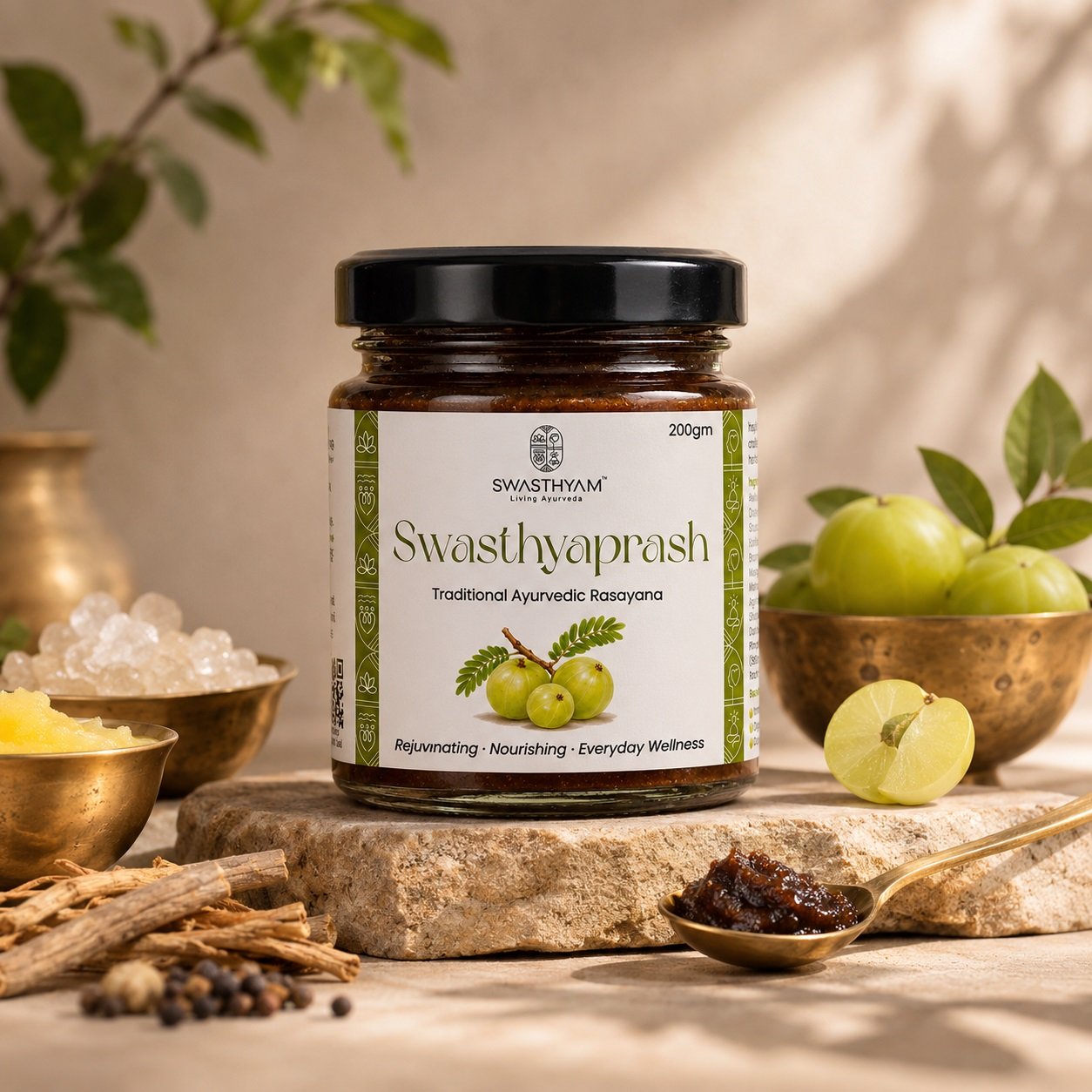
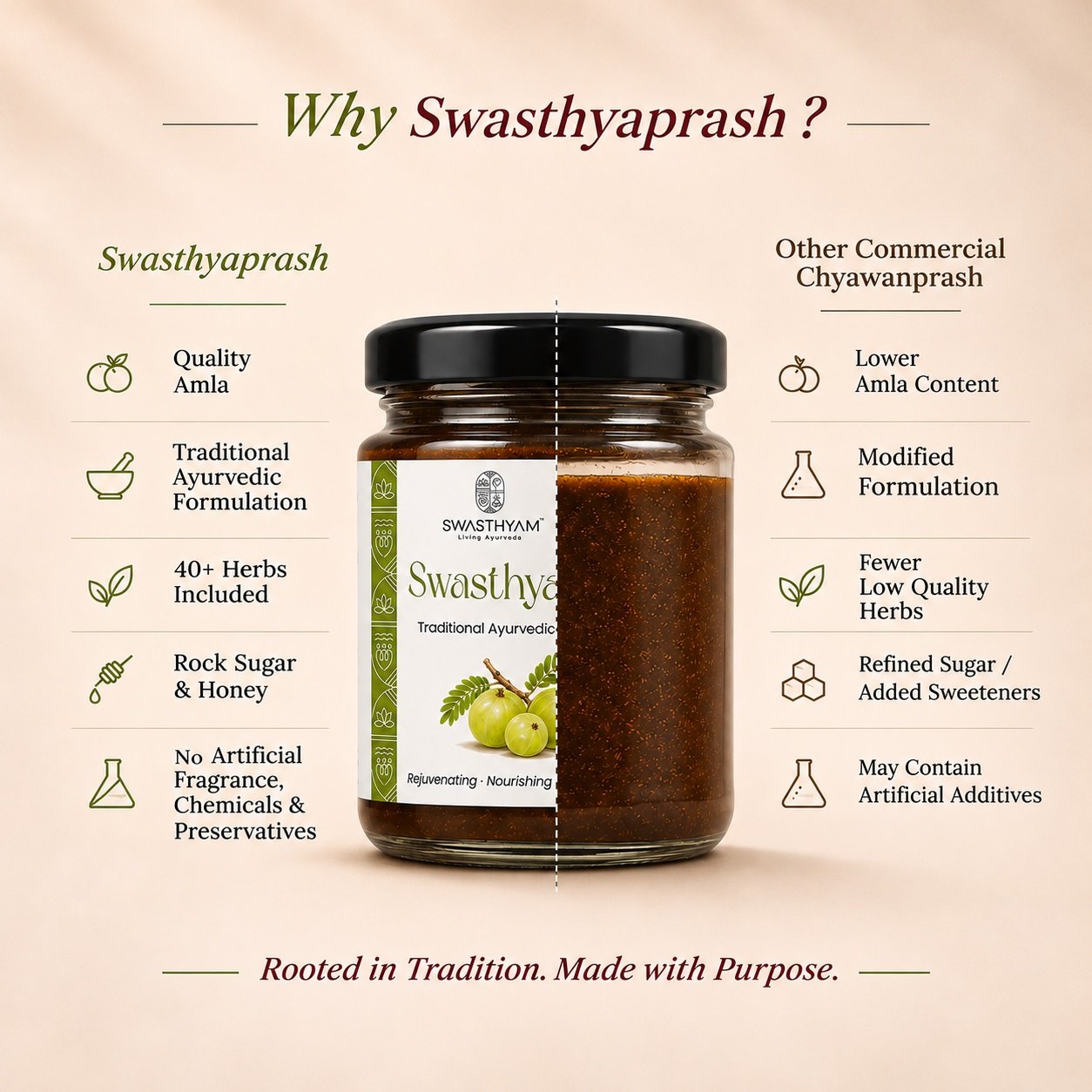
Swasthyaprash is our classical chyawanprash, a winter rasayana made only in amla season, when amla is truly ready. Fresh amla is slowly cooked with Gir cow ghee, mishri and more than 40 herbs, following the classical recipe step by step, under a vaidya’s guidance. Each batch takes five days and is made in limited quantity.
Free with every order: “A Warm Winter, the Ayurveda Way“, our 12-page winter guide.
- 100% Natural
- 100% Ayurvedic
₹399.00 – ₹749.00Price range: ₹399.00 through ₹749.00
(MRP Inclusive of all taxes)
Key Ingredients
Amla
The heart of chyawanprash. Ayurveda counts amla among the finest rasayanas. It is used fresh and only in its season, which is why Swasthyaprash is made only in winter.
Gir cow ghee
Ghee from Gir cows carries the herbs and gives the prash its richness. The amla is slowly roasted in it, a classical step called भर्जन (bharjan).
Mishri (rock sugar)
The base of the पा क (paak), the slow cooking that turns amla and herbs into a prash.
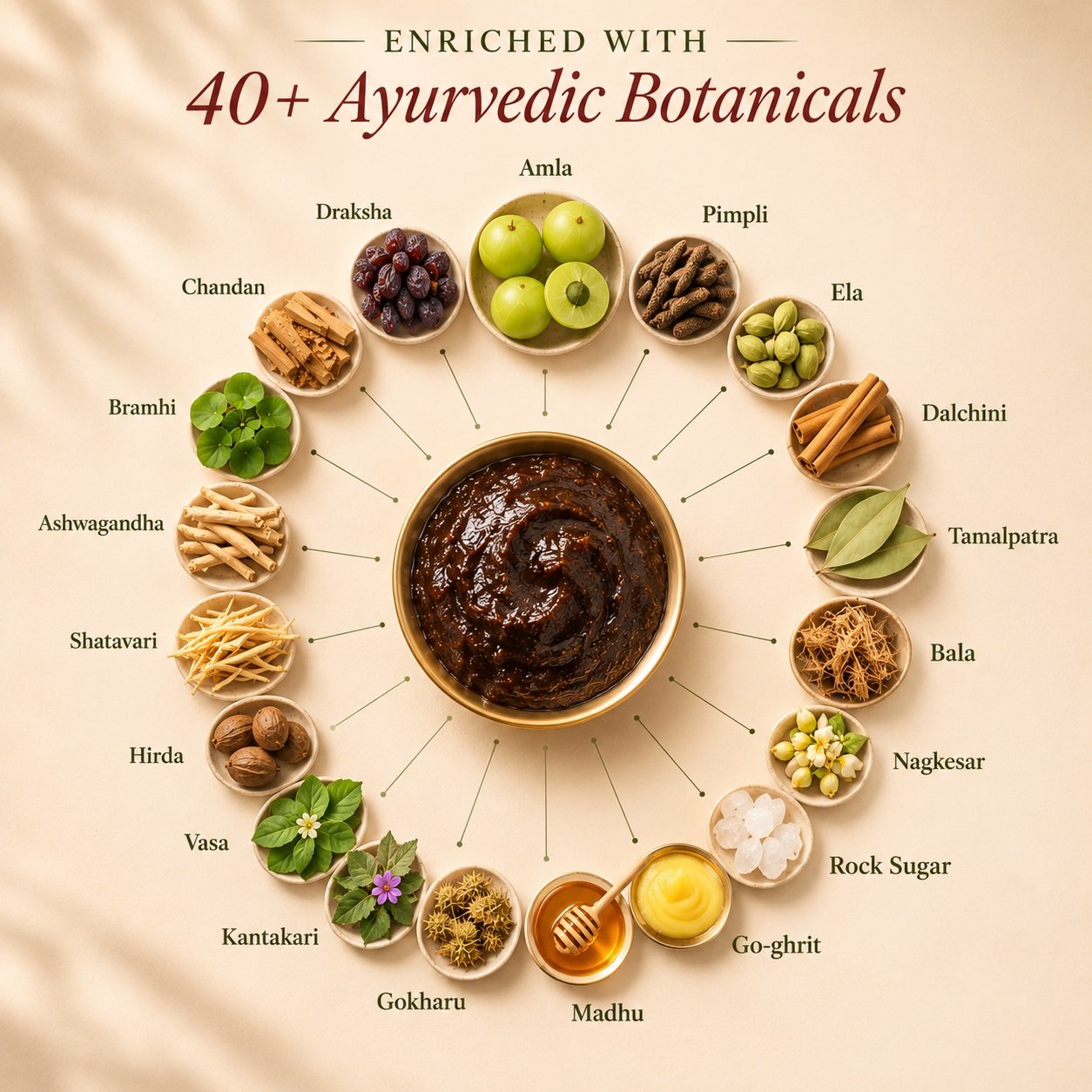
40+ herbs
Not a random mix, but classical groups chosen for a purpose: Dashamool (ten roots), the nourishing Ashtavarga herbs, herbs traditionally used for the chest, and Chaturjat, the four aromatics added at the end.
Product Description
Long before the world spoke of daily supplements, Ayurveda had a word for daily nourishment: rasayana. Of all the rasayanas described in the classical texts, chyawanprash is the best known, and it is still made the same way.
At its heart is amla, and amla has a season. The classical texts say chyawanprash should be made in winter, when amla is fully ready on the tree. So we make Swasthyaprash only once a year, with fresh amla.
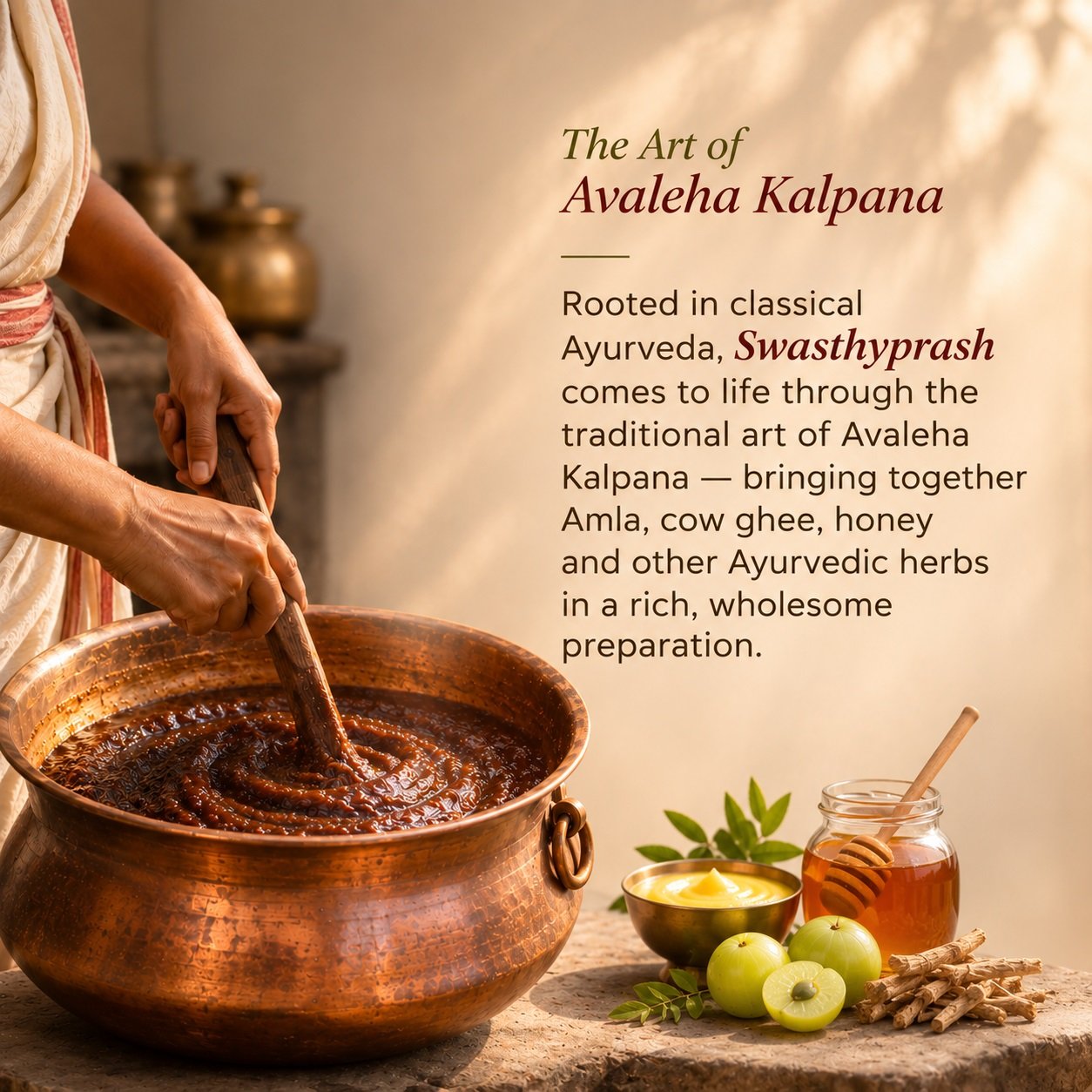
Every step follows the classical method: a decoction of more than 40 herbs, amla cooked soft in it, slow roasting in Gir cow ghee, and the paak with mishri. Honey and aromatic herbs go in only after it cools. It takes five days, under a vaidya’s guidance.
We fill it in small 200 g glass jars, so it is finished while it is fresh rather than left on a shelf.
Because it is made once a season, the quantity is limited.
TRADITIONALLY TAKEN FOR
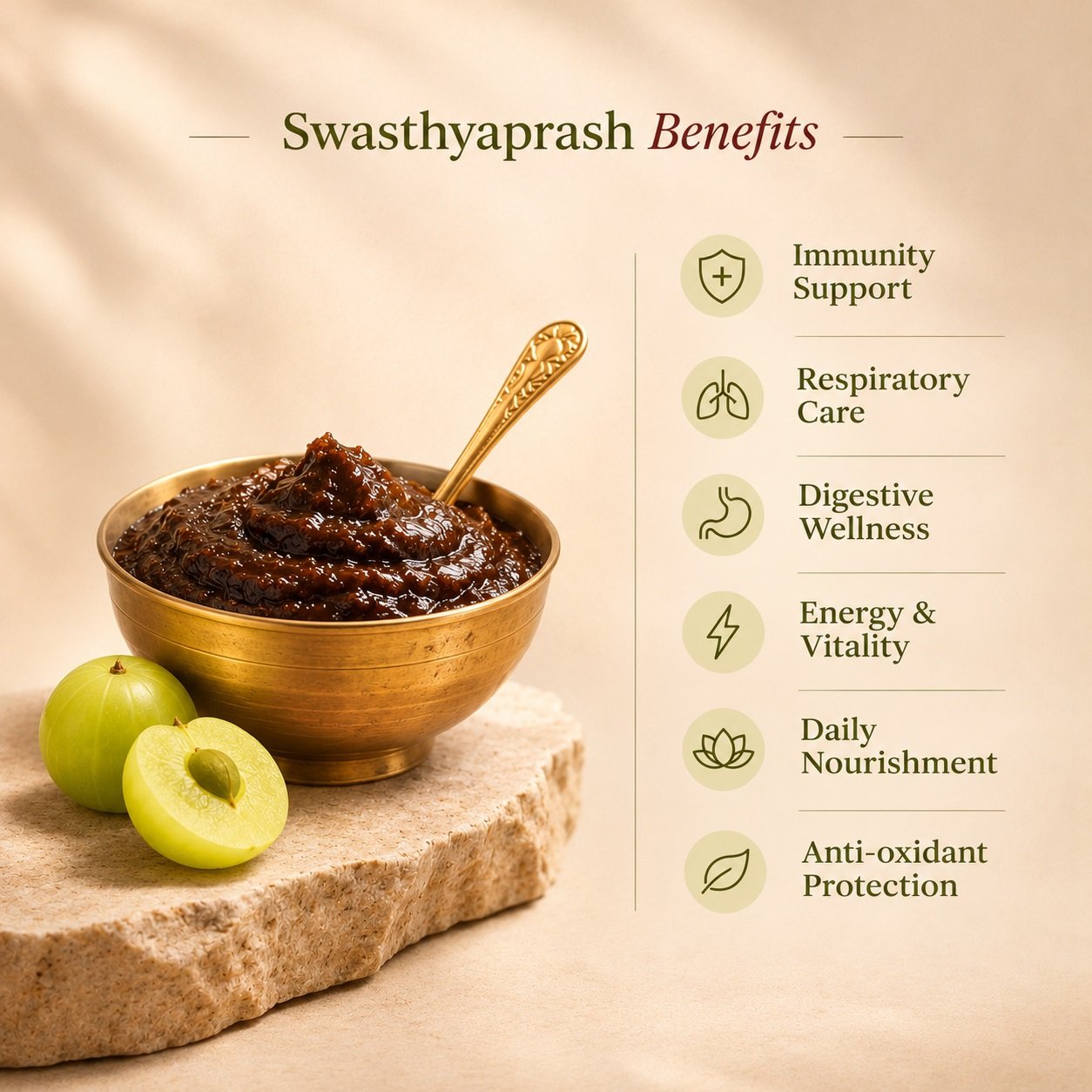
In Ayurveda, chyawanprash is a rasayana, a nourishing food taken daily. Traditionally, it is taken in winter:
- as part of a daily winter routine
- for strength and nourishment through the cold months
- with herbs classically used for the chest and breathing
- as one classical recipe that brings together more than 40 herbs in a single spoon
These are traditional uses described in Ayurvedic texts, not medical claims.
WHO IS IT FOR?
Adults and children above 1 year, especially in winter.
Not suitable for people with diabetes. Not for babies under 1 year, as it contains honey. If you are pregnant, unwell or on any medication, please ask your vaidya first.
HOW TO USE?
Our vaidya suggests two ways:
- If you have breakfast or tea in the morning: adults half a teaspoon, children a quarter
teaspoon, with your morning routine. - If you can skip breakfast: adults 1 to 1½ teaspoons on an empty stomach, then eat
when you feel hungry, 3 to 4 hours later
Take it plain. If you feel very hungry in the morning or tend to get acidity, take it with milk. You can take it all year; winter is when it benefits you most. A 200 g jar lasts about two months at half a teaspoon a day.
MADE WITHOUT
- Preservatives
- Artificial colours
- Synthetic fragrance
- Artificial flavours
Pure ingredients, a classical method and five days of patience
LIVE SLOW
Some things can’t be hurried. Amla waits for its season, and the prash takes five days. We
would rather make a small batch right than a large one any other way.
Rooted in seasons. Made with patience.
FULL INGREDIENT LIST
| Ingredient | Per 10 g |
|---|---|
| Amla (Awla), fresh | 4.3 g |
| Mishri (rock sugar) | 3.12 g |
| Madhu (honey) | 360 mg |
| Gir cow ghee | 360 mg |
| Til oil (sesame) | 360 mg |
| Vanshalochan | 120 mg |
| Pippali (Pimpli) | 90 mg |
| Ela (cardamom) | 60 mg |
| 30 mg each: Bala, Kakadshingi, Bhuiawla, Draksha, Musta, Punarnava, Vasa, Hirda, Shatavari, Vidarikand, Kachora, Pushkarmool, Kaknasa, Kamal, Varahikand, Ashwagandha, Brahmi, Agaru, Chandan, Mashparni, Mudgaparni, Jivanti, Riddhi, Vruddhi, Meda, Mahameda, Kakoli, Kshirkakoli, Bel, Shyonak, Agnimanth, Patla, Gambhari, Prushnaparni, Shalparni, Gokharu, Kantakari, Bruhati, Dalchini, Tamalpatra, Nagkesar | 30 mg each (41 herbs) |
Contains milk (ghee).
FREQUENTLY ASK QUESTIONS
Q1. What is Swasthyaprash?
Ans.
Swasthyaprash is Swasthyam’s chyawanprash, made to the classical recipe, only in amla season.
Q2. What makes Swasthyaprash different?
Ans.
- Made only in amla season, with fresh amla: 4.3 g of amla in every 10 g
- Follows the classical recipe, with more than 40 herbs in their classical groups
- Made under a vaidya’s guidance
- Each batch takes five days
- No preservatives
- Packed in small 200 g glass jars, to be finished while fresh
Q3. Why is it available only in limited quantity?
Ans.
Because amla has a season. We make Swasthyaprash once a year, when amla is ready, and we would rather make a small batch with care than a large one in a hurry.
Q4. How is it made?
Ans.
- क्वाथ (Kwath): the herbs are boiled in water to make a decoction.
- स्वेदन (Swedan): fresh amla is cooked in this decoction until soft, then made into a pulp.
- भर्जन (Bharjan): the pulp is slowly roasted in Gir cow ghee and til oil.
- पाक (Paak): it is cooked with mishri until it becomes a prash.
- प्रक्षेप (Prakshep): after cooling, the aromatic herbs and honey are added. Honey is never heated, as the classical texts instruct.
Q5. How should I store it?
Ans.
Keep the lid tightly closed and store the jar in a cool, dry place, away from sunlight. Always use a dry spoon. Best finished within the season.
Q6. Can children have it?
Ans.
Yes, children above 1 year: a quarter teaspoon in the morning. It is not for babies under 1 year, as it contains honey.
Q7. Can people with diabetes take it?
Ans.
No. Swasthyaprash contains mishri and honey, so it is not suitable for people with diabetes.
Q8. Can I take it all year?
Ans.
Yes. You can take it all year; winter is when it benefits you most.
Q9. Is shipping free?
Ans.
Shipping is free on orders above ₹599. The pack of 2 jars ships free, and so does one jar with Turmeric Brew or Abhyanga Body Oil.
Key Ingredients
Amla
The heart of chyawanprash. Ayurveda counts amla among the finest rasayanas. It is used fresh and only in its season, which is why Swasthyaprash is made only in winter.
Gir cow ghee
Ghee from Gir cows carries the herbs and gives the prash its richness. The amla is slowly roasted in it, a classical step called भर्जन (bharjan).
Mishri (rock sugar)
The base of the पा क (paak), the slow cooking that turns amla and herbs into a prash.
40+ herbs
Not a random mix, but classical groups chosen for a purpose: Dashamool (ten roots), the nourishing Ashtavarga herbs, herbs traditionally used for the chest, and Chaturjat, the four aromatics added at the end.
Product Description
Long before the world spoke of daily supplements, Ayurveda had a word for daily nourishment: rasayana. Of all the rasayanas described in the classical texts, chyawanprash is the best known, and it is still made the same way.
At its heart is amla, and amla has a season. The classical texts say chyawanprash should be made in winter, when amla is fully ready on the tree. So we make Swasthyaprash only once a year, with fresh amla.
Every step follows the classical method: a decoction of more than 40 herbs, amla cooked soft in it, slow roasting in Gir cow ghee, and the paak with mishri. Honey and aromatic herbs go in only after it cools. It takes five days, under a vaidya’s guidance.
We fill it in small 200 g glass jars, so it is finished while it is fresh rather than left on a shelf.
Because it is made once a season, the quantity is limited.
TRADITIONALLY TAKEN FOR
In Ayurveda, chyawanprash is a rasayana, a nourishing food taken daily. Traditionally, it is taken in winter:
- as part of a daily winter routine
- for strength and nourishment through the cold months
- with herbs classically used for the chest and breathing
- as one classical recipe that brings together more than 40 herbs in a single spoon
These are traditional uses described in Ayurvedic texts, not medical claims.
WHO IS IT FOR?
Adults and children above 1 year, especially in winter.
Not suitable for people with diabetes. Not for babies under 1 year, as it contains honey. If you are pregnant, unwell or on any medication, please ask your vaidya first.
HOW TO USE?
Our vaidya suggests two ways:
- If you have breakfast or tea in the morning: adults half a teaspoon, children a quarter
teaspoon, with your morning routine. - If you can skip breakfast: adults 1 to 1½ teaspoons on an empty stomach, then eat
when you feel hungry, 3 to 4 hours later
Take it plain. If you feel very hungry in the morning or tend to get acidity, take it with milk. You can take it all year; winter is when it benefits you most. A 200 g jar lasts about two months at half a teaspoon a day.
MADE WITHOUT
- Preservatives
- Artificial colours
- Synthetic fragrance
- Artificial flavours
Pure ingredients, a classical method and five days of patience
LIVE SLOW
Some things can’t be hurried. Amla waits for its season, and the prash takes five days. We
would rather make a small batch right than a large one any other way.
Rooted in seasons. Made with patience.
FULL INGREDIENT LIST
| Ingredient | Per 10 g |
|---|---|
| Amla (Awla), fresh | 4.3 g |
| Mishri (rock sugar) | 3.12 g |
| Madhu (honey) | 360 mg |
| Gir cow ghee | 360 mg |
| Til oil (sesame) | 360 mg |
| Vanshalochan | 120 mg |
| Pippali (Pimpli) | 90 mg |
| Ela (cardamom) | 60 mg |
| 30 mg each: Bala, Kakadshingi, Bhuiawla, Draksha, Musta, Punarnava, Vasa, Hirda, Shatavari, Vidarikand, Kachora, Pushkarmool, Kaknasa, Kamal, Varahikand, Ashwagandha, Brahmi, Agaru, Chandan, Mashparni, Mudgaparni, Jivanti, Riddhi, Vruddhi, Meda, Mahameda, Kakoli, Kshirkakoli, Bel, Shyonak, Agnimanth, Patla, Gambhari, Prushnaparni, Shalparni, Gokharu, Kantakari, Bruhati, Dalchini, Tamalpatra, Nagkesar | 30 mg each (41 herbs) |
Contains milk (ghee).
FREQUENTLY ASK QUESTIONS
Q1. What is Swasthyaprash?
Ans.
Swasthyaprash is Swasthyam’s chyawanprash, made to the classical recipe, only in amla season.
Q2. What makes Swasthyaprash different?
Ans.
- Made only in amla season, with fresh amla: 4.3 g of amla in every 10 g
- Follows the classical recipe, with more than 40 herbs in their classical groups
- Made under a vaidya’s guidance
- Each batch takes five days
- No preservatives
- Packed in small 200 g glass jars, to be finished while fresh
Q3. Why is it available only in limited quantity?
Ans.
Because amla has a season. We make Swasthyaprash once a year, when amla is ready, and we would rather make a small batch with care than a large one in a hurry.
Q4. How is it made?
Ans.
- क्वाथ (Kwath): the herbs are boiled in water to make a decoction.
- स्वेदन (Swedan): fresh amla is cooked in this decoction until soft, then made into a pulp.
- भर्जन (Bharjan): the pulp is slowly roasted in Gir cow ghee and til oil.
- पाक (Paak): it is cooked with mishri until it becomes a prash.
- प्रक्षेप (Prakshep): after cooling, the aromatic herbs and honey are added. Honey is never heated, as the classical texts instruct.
Q5. How should I store it?
Ans.
Keep the lid tightly closed and store the jar in a cool, dry place, away from sunlight. Always use a dry spoon. Best finished within the season.
Q6. Can children have it?
Ans.
Yes, children above 1 year: a quarter teaspoon in the morning. It is not for babies under 1 year, as it contains honey.
Q7. Can people with diabetes take it?
Ans.
No. Swasthyaprash contains mishri and honey, so it is not suitable for people with diabetes.
Q8. Can I take it all year?
Ans.
Yes. You can take it all year; winter is when it benefits you most.
Q9. Is shipping free?
Ans.
Shipping is free on orders above ₹599. The pack of 2 jars ships free, and so does one jar with Turmeric Brew or Abhyanga Body Oil.
Customer Reviews*
Related Products
-
Swasthyam Diwali Combo
₹135.00 – ₹340.00Price range: ₹135.00 through ₹340.00 This product has multiple variants. The options may be chosen on the product pageRated 0 out of 5 -
Suvasik Utane- Ayurvedic Herbal Ubtan
₹95.00 – ₹180.50Price range: ₹95.00 through ₹180.50 This product has multiple variants. The options may be chosen on the product pageRated 0 out of 5 -
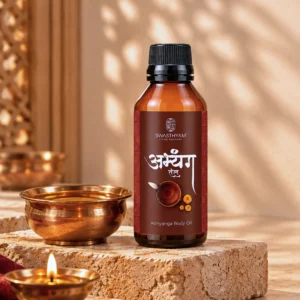
Abhyanga Body Oil
Rated 4.33 out of 5₹225.00Original price was: ₹225.00.₹216.00Current price is: ₹216.00. -
Gulkand-Rose Preserve
Rated 0 out of 5₹275.00Original price was: ₹275.00.₹261.25Current price is: ₹261.25. -
Turmeric Brew
Rated 4.42 out of 5₹240.00Original price was: ₹240.00.₹216.00Current price is: ₹216.00. This product has multiple variants. The options may be chosen on the product page


Reviews
There are no reviews yet.